
I am an MSc student in Artificial Intelligence and Robotics at The Chinese University of Hong Kong, Shenzhen, advised by Prof. Rui Huang. Before that, I received bachelor's degrees in Information Statistics and Data Science from Kangwon National University and worked as a data scientist at Connple.
My research interests are uncertainty calibration for learned perception and 3D scene representation for robotics, including perception under compute and communication constraints and real-time reconstruction of dynamic scenes. I want robots to know when their own perception should not be trusted.
I also founded TARS, a foot-traffic analytics service built on computer vision and used by over 60 small businesses.
I am applying to PhD programs for Fall 2027.
Research
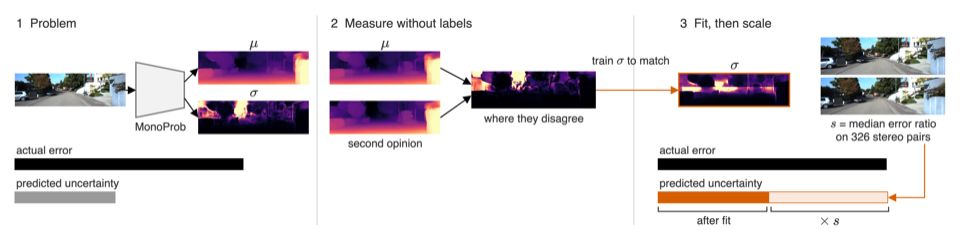
Range-Aware Uncertainty Calibration in Self-Supervised Monocular Depth
MSc thesis, 2026. Paper in preparation with Prof. Rui Huang.
Many robotic systems act on the magnitude of learned depth uncertainty, yet the uncertainty of self-supervised depth models is almost always evaluated by ranking, so that magnitude goes unchecked. I show that self-supervised retraining alone cannot close this gap, while a single label-free scale constant estimated from stereo residuals can. This cuts worst-range calibration error by 86% compared with the original model, with no ground-truth depth used in training or calibration.
project page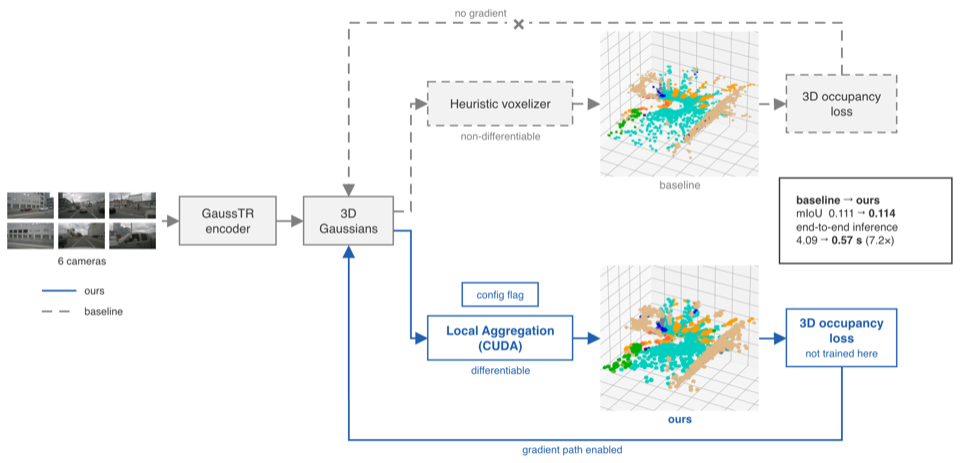
LocalAggTR: Differentiable Voxelization for Weakly Supervised 3D Occupancy
Capstone project, 2025. Awarded Distinction.
The Gaussian-to-voxel step in GaussTR is non-differentiable and dominates inference time. I replaced it with a differentiable Local Aggregation operator that passes occupancy gradients, making inference 7.2× faster with mIoU unchanged on nuScenes. Adopted by the lab's 3D Gaussian Splatting project for semi-supervised fine-tuning.
code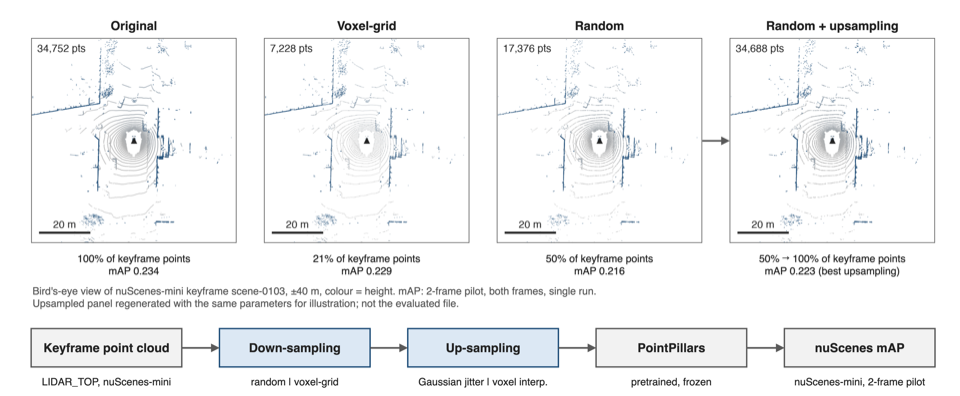
Point Cloud Density and 3D Object Detection
2025.
How does a 3D detector degrade when LiDAR density drops, and can upsampling recover it? With PointPillars on nuScenes-mini, voxel-grid thinning to one fifth of the points cost 2.1% of mAP, while random thinning to half cost about 4× more.
code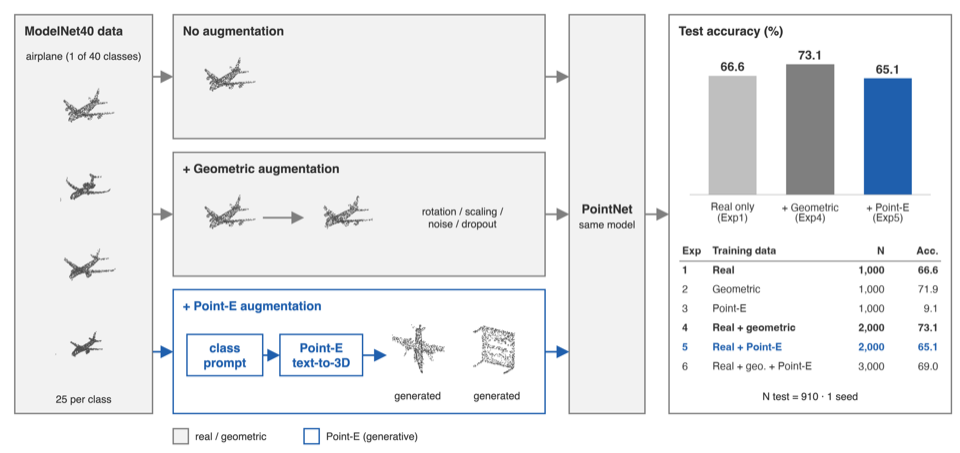
Geometric vs. Generative 3D Augmentation for Point Cloud Classification
2025.
Does text-to-3D generative augmentation help a point cloud classifier more than geometric augmentation? With PointNet on ModelNet40, geometric augmentation raised accuracy by 6.5 points, while text-to-3D generative augmentation did not help.
code